

Date Submitted: Jul 17th 2026
To: NZX (Policy Team)
Tap/Click here to download submission
The NZ Shareholders’ Association (“NZSA”) has prepared this paper as a response to the consultation launched by NZX in relation to the potential introduction of companies with dual-class share structures to the New Zealand Exchange. These are currently not permitted under the current NZX Listing Rules.
We welcome further engagement as may be required to clarify or comment further on any statements in this paper. NZSA appreciates the opportunity to provide our perspective on this matter.
About NZSA
NZSA is a non-profit entity that advocates for all investors, regardless of age or experience. Our vision is to protect, enable and reward investing, through being a trusted and respected voice for investors.
Background
NZSA previously commented on dual class shares in a submission to NZX made in September 2022, relating to Capital Raise settings and Listing Options. At that time, we considered that the topic warranted further study, but did not support the blanket introduction of dual class share structures based on differential voting power, given existing levels of shareholder concentration in listed companies. We note that this current consultation includes a broader objective of providing “appropriate investor protections for those investing in ordinary shares that form part of a DCS structure”.
NZSA Commentary
1. Supportive: NZSA recognises the desire to improve capital market participation in New Zealand. Given the key settings associated with the NZX proposals, NZSA is broadly supportive of the introduction of dual-class share listings within the Listing Rules. However, we would not wish to see settings “relaxed” further in future or as a result of this consultation.
2. Disclosure, Voting and Governance: NZSA is supportive of the disclosure requirements proposed by NZX. We also support the NZX proposal extending into voting restriction and governance structure requirements, given that these are both key forms of investor protection.
3. Representative Directors: We are pleased to note the inclusion of both Superior and Ordinary shareholder representative directors as part of the NZX proposals. Regardless of representation, all directors remain bound to act in the best interests of the company.
We also note that regardless of representation, such directors are still able to be independent.
4. Board Composition: Given the board composition settings proposed, this is likely to result in dual-class shareholding companies maintaining a majority of independent directors. This acts as another key protection for ordinary shareholders.
NZSA often hears reluctance expressed by Boards of issuers with major shareholders to appoint a majority of independent directors, as non-independent directors are required to act in the best interests of the company while noting that the Board composition “reflects the shareholding”.
We have long considered this a weak argument, given that the counter-factual is also true: a majority of independent directors are required to act in the best interests of the company, regardless of shareholding base (including major shareholders).
5. One Class: NZSA considers that the Rules should specify only one class of Superior Shares for any dual-class shareholding entity. This avoids the complexity of multi-class shareholding structures commonly found in wholesale or private companies.
6. Time-bound: As noted in this submission, NZSA considers that a brightline time limit of 7 years should be considered as a limitation for dual-class share issuers. This should, however, be subjected to a vote of Ordinary shareholders (excluding related parties of Superior Shareholders) that may allow the dual class status of the issuer to be extended for a further 7 years.
7. Control Ratio: The NZX proposals ensure that the voting ratio at the time of listing cannot increase over time through the issuance and/or redemption of Superior Shares.
Even with this setting, however, NZSA notes that the voting power exercised by Superior shareholders in relation to their economic ownership would continue to increase (a common criticism of regimes in other jurisdictions).
A primary setting restricting the Control Ratio (Voting Ownership / Economic Ownership) overcomes this issue by placing a cap on the mathematical relationship of economic ownership to voting control.
Please see our worked example in our response to Section B, Question 2 below.
NZX Consultation Questions
Section A: Eligibility
1. Do you agree that DCS structures should only be available for new Listings? If NZX were to enable Issuers to become DCS Issuers, what additional requirements should apply over and above the existing protections in the Rules (e.g. the related party and major transaction requirements)?
NZSA supports the intention of NZX to only allow dual-class share listings for new listings only, as this preserves the rights and obligations of existing shareholders within existing listings, and the intrinsic value attached to those rights and obligations.
Were an existing listed entity given scope to amend its constitution to introduce a dual-class share structure, this has the potential to introduce a value gap not considered by the shareholder at the time of their investment.
NZSA notes that there is still a potential pathway for existing listed companies to introduce a dual-class share structure, through a process of seeking shareholder approval to implement constitutional amendments and de-list, with the subsequent issue of a new product disclosure statement and re-listing.
However, NZSA also considers that companies that list after the introduction of a dual-class share regime should be allowed to maintain the ability to implement a dual-class share structure. This avoids a potential unintended consequence of all future listings being undertaken on a dual-class basis (even where there is no practicable difference in shareholder rights), as a means of preserving future optionality.
2. Do you agree that NZX should require holders of Superior Shares to have a minimum 10% interest in a DCS Issuer at the time of its Quotation?
Yes.
The proposed threshold strikes an appropriate balance in the equity pathway of a founder raising additional capital while maintaining meaningful economic ownership.
NZSA notes that this threshold level is somewhat dependent on the voting ratio attached to any Superior shares.
3. Are there any specific factors that should be considered by a DCS Issuer when determining its ‘anticipated market capitalisation’, that NZX could usefully refer to in guidance for the purpose of supporting an applicant in assessing its ‘anticipated market capitalisation’?
NZSA believes that any factor-based guidance relating to “anticipated market capitalisation” should not apply specifically to dual-class share issuers.
Such factors may be useful in the context of any new direct listing, IPO or for post-capital raise expectations for existing listed companies.
Nonetheless, NZSA does not believe that this should form a key priority for NZX at this time; the higher priority is to ensure the most effective conditions for price discovery through normal trading.
4. Do you consider that NZX should impose spread requirements on non-Quoted Superior Shares?
No.
While a spread requirement supports price discovery for a listed security through the collective power of individuals providing liquidity, this does not support all equity pathways. For example, a spread requirement for Superior shares may suit a ‘co-operative’ structure considering a listing, but is less likely to be appealing to a business founder looking to raise additional capital or provide for an eventual ownership succession pathway.
Section B: Superior Shares
1. Are there any additional matters in respect of which holders of Superior Shares should vote on a 1 vote: 1 share basis, or any matters that should be removed from Rule 2.16.1(h)?
(note – NZSA believes that this question should refer to proposed Rule 2.15.1(h)
Voting Ratio: NZSA notes that most markets with dual class shareholder regimes operate with either market regulation or market expectations of a 10:1 voting ratio, as considered in the NZX consultation document.
At the 10% minimum ownership threshold described above, this allows the holders of Superior Shares to control the company, as this results in a shareholder vote greater than 50% of shares.
Restrictions: NZSA is therefore supportive of Superior Shares voting on a 1:1 basis on the matters expressed in section 2.2 of the consultation document, and the proposed Rule 2.15.1(h) of the Listing Rules. We note this includes amendment of the company’s governing document, director appointment and removal, the issuance of new equity securities, liquidation and de-listing.
We note that the Swedish Stock Exchange (unlike Singapore or Hong Kong) offers no voting restrictions on Superior Shareholders for any director appointments. However, unlike New Zealand, we note the prevalence of shareholder-based Nomination Committees that drive director appointments, before being put to the full shareholder base as resolutions.
On this basis, NZSA would not support a dual-class regime that offered no voting limitations for Superior Shareholders on director appointments.
2. Do you consider the proposed anti-dilution protections to be appropriate?
NZSA supports the intent to not allow the proportion of Superior to Ordinary shares to increase post-listing.
Should a company raise capital post listing, this is likely to encourage greater issuance of Ordinary shares, allowing a natural transition between the role of Superior shareholders and the increasing economic ownership of ordinary shareholders.
However, we also encourage NZX to consider provisions that restrict an increase in the “control ratio” exercised by Superior Shareholders over time (see worked example below).
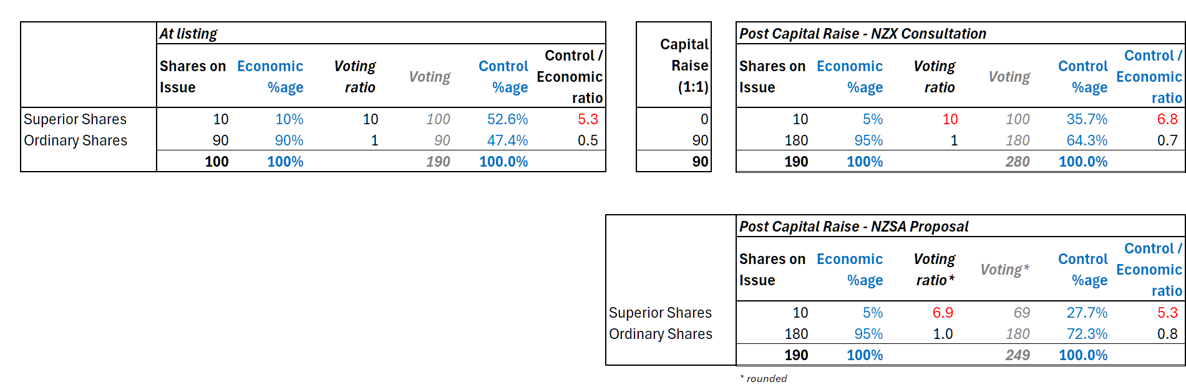
a. For example, a company that has listed at the threshold minimum of a 10% Superior Shareholding will result in Superior Shareholders controlling 52.6% of a vote with 10% economic ownership – an ‘control ratio’ of 5.26
b. Raising capital at a 1:1 ratio (assuming no participation by Superior Shareholders) will result in a control ratio of 6.79; ie, despite the reduction in voting power for the Superior Shareholding, the level of control relative to economic ownership has increased.
c. Limiting the control ratio to that at listing over time encourages Superior shareholders to retain ‘skin in the game’ on listing, while capping long-term influence to what was known at the time of listing.
d. This proposal would see the critical metric post-listing become the control ratio, rather than the voting ratio, preventing increasing divergence between control and economic influence.
3. Is it appropriate to restrict the acquisition or redemption of Superior Shares so that a DCS Issuer may not acquire or redeem Superior Shares where that acquisition or redemption would proportionately increase the Superior Shareholding from that which existed at the date of Quotation, as a result of an acquisition or redemption?
Yes
Should similar restrictions be applied in relation to capital raising or transfers of Superior Shares?
Yes – please see our comments and worked example in Queston (2) above.
Under the NZSA proposal above, limiting the Control ratio at the time of listing would also encourage holders of Superior Shares to participate in capital raise initiatives (via the issuance of Ordinary shares).
4. Are there any additional matters that should trigger the dissolution of the DCS Issuer? Do you consider that the current trigger events are appropriate?
We consider that a brightline time limit of 7 years should be considered as a limitation for dual-class share issuers. This should, however, be subjected to a vote of Ordinary shareholders (excluding related parties of Superior Shareholders) that may allow the dual class status of the issuer to be extended for a further 7 years.
Section C: Governance
1. NZX is proposing to retain the current board composition requirements relating to Director independence, and to include requirements for the appointment of ‘representative ‘ Directors appointed by each Class of shareholders. Do you consider that any changes should be made to the Director independence settings for DCS Issuers?
Yes.
We also re-iterate that that Directors retain the legal obligation to act in the best interests of the company. This should not be confused with whom Representative Directors represent under the NZX proposals.
2. NZX considers that it remains appropriate for Code Recommendation 2.8 that recommends an Issuer’s board is comprised of a majority of Independent Directors to apply to DCS Issuers. Do you consider any amendments are needed to this recommendation for DCS Issuers?
NZSA believes that requiring a majority of independent directors for dual-class share issuers would offer an important safeguard for ordinary shareholders. Despite this comment, it is likely that the NZX proposal related to committee composition requirements (see Question 4 below) would incentivise a dual class issuer to propose a majority of independent directors.
Regardless of any specific rule, we do not consider that any revision is required to the Code.
3. Do you consider it appropriate for NZX to require a DCS Issuer to maintain a bespoke DCS Governance Committee?
Yes.
This has similarity to the Independent Directors Committee prevalent in companies that operate with a large shareholder. Given the voting control influence of Superior Shareholders, NZSA sees this committee as critical for any dual-class issuer.
4. Do you consider that proposed Board Committee composition requirements to be appropriate? Are these settings likely to cause any practical difficulties for DCS Issuers?
NZSA is supportive of independent directors forming a majority of the Audit, Nomination and Remuneration Committees as a Rules requirement.
We recognise the additional onus this may place on dual-class issuers to ensure they have enough independent directors with appropriate skills to cover the required workload. In the long-term, however, we consider this offers future benefits for NZX, investors and the director community in New Zealand:
- Greater opportunity for the development of new directors and a “broadening” of the director community.
- A less risk-averse approach to director appointment and governance delivery.
- Greater investor confidence in New Zealand markets (including international investors).
For dual-class issuers, we believe that any steps/protection such a company is able (or required) to take to mitigate investor concern on issues relating to control or governance will ultimately support investor confidence in the dual-class issuer.
This also acts as a further incentive for a dual class issuer to maintain a majority of independent directors.
We encourage NZX to consider extending the Rules requirement for an independent director majority on Committees to most NZX-listed companies (note that we are likely to clarify this position further as part of the Tiered Compliance Consultation to be finalised in August this year).
Section D: Disclosure
1. Do you consider that any amendments are required to the prescribed form of the template warning statement?
No.
The proposed statement offers clarity in a simple form for prospective investors.
2. Is there any additional specific information that NZX should require to be included in a DCS Issuer’s Offer Document or Profile?
Under the NZX proposal, Superior voting rights carry up to 10x the voting power of Ordinary shares. Should the NZSA proposal be considered further in the context of subsequent capital issuance, the Superior Shareholders voting ratio may change.
On this basis, NZSA considers that the voting ratio of Superior Shares (compared with Ordinary Shares) should also be disclosed in the offer document and listing profile.
3. Are there any other matters in respect of which NZX should provide guidance relating to the application of the continuous disclosure regime?
No. NZSA is comfortable with the NZX proposal for a guidance note to support what constitutes Material Information in the context of Superior shareholders.
NZSA does not support the ‘blanket’ disclosure of share trades of Superior Shares. Existing Rules cover the requirements as to when a sale of shares needs to be disclosed; there should be no further need for Rule development specifically for Superior shares.
This is particularly applicable where the Superior shareholding class is defined broadly, or where where retail investors are able to purchase shares. Rangatira Limited (listed on USX) forms an example where ‘A’ and ‘B’ shares are able to be owned by anyone.
4. Are there any practical issues for a DCS Issuer being required to notify substantial product holding information for non-Quoted Superior Shares based on the holdings it has recorded on its share register?
No. Even if not listed, this still forms a key part of investor information for the listed Ordinary shares and/or debt instruments.
Section E: Capital Raising
1. Do you consider that NZX should enable a DCS Issuer to issue Superior Shares without shareholder approval in any additional circumstances?
NZSA supports the NZX proposals outlined in the consultation document.
2. Are there any additional requirements that NZX should impose in relation to capital raising activities of a DCS Issuer to protect the rights of Ordinary Shareholders?
NZSA broadly supports the mechanisms outlined in section 5 of the NZX consultation document.
Note the comment (and NZSA proposal) for the economic/control ratio sor Superior Shareholders to not increase beyond the ratio at the time of listing.
Oliver Mander
Chief Executive, NZSA
July 17th 2026