

Date submitted: 15 September 2026
To: Ministry of Business, Innovation and Employment (MBIE)
Tap/Click here to download submission
New Zealand’s approach to capital markets regulation
0.1What regulatory settings would you like to see considered for change in the next phase?
NZSA supports the consultation process that underpins these reform proposals, and broadly supports the key priority objectives (see section 0.2)
We also believe that there are further regulatory topics that could improve the ongoing growth and competitiveness of New Zealand’s capital markets.
- Mutual recognition: Settings to improve the ‘inter-connectedness’ of New Zealand capital markets to those of other jurisdictions (eg, mutual recognition of settings in other credible jurisdictions to encourage foreign listings)
- Taxation: NZSA is concerned at the significant tax differential that has emerged between different approaches to the same types of investment. We encourage Government to consider the significant differential between the marginal tax rates faced by individual investors (up to 39%), the general trust income tax rate (39%) as compared with the maximum prescribed investor rate (PIR) for individuals investing in a Portfolio Investment Entity (28%). The tax treatment of any gains can also differ. NZSA considers that this creates a distortion in the capital market that is biased against individual investors who choose to self-manage their investments.
- Co-operatives: We see some potential for the evolution of capital settings related to co-operative industry structures, to improve disclosure, liquidity but above all capital funding and productivity. See section 0.8 below.
- Look-through: A key focus of NZSA’s submission is the establishment of company-based thresholds to determine proportionate regulation and compliance settings. One of the key determinants is shareholder numbers. The increase in custodial and nominee relationships has already made it more difficult to establish underlying shareholder numbers. If shareholder numbers were to become a determinant for appropriate proportionate compliance settings, greater transparency of underlying beneficial ownership would become more important.
0.2Do you support the three objectives for change framing this document? What objectives would you recommend to guide considerations of future changes?
NZSA supports the three objectives identified in the consultation document, although offers an additional over-arching objective that should define the Phase 2 reforms.
Balance: We note that proportionate regulation offers a solution, rather than an objective in its own right. We would express the objective as “Setting an appropriate balance between access to capital and investor protection”, with proportionate tools and thresholds as a key legislative toolkit to support its delivery. This balance is explicitly referenced in paragraph 41 of the consultation document, as one of the key challenges to overcome.
Appropriate investor protection settings support market confidence, amongst both domestic and international investors.
We also note that the Financial Markets Conduct Act (‘FMCA’) has two key purposes, including to “Promote confident and informed participation by businesses, investors and consumers in financial markets.” NZSA considers this a relevant objective in the context of this review.
Proportionate regulation: NZSA has advocated for a proportionate regulation regime acting as a backdrop to legislative reform since at least 2022. Our advocacy has focused on the introduction of appropriate thresholds supporting disclosure requirements, regardless of the listing status of the company.
We consider the number of shareholders (on a look-through basis) a key public interest test in determining the relevant degree of compliance for disclosures and some structural elements (eg, audit/review).
While this reform proposal focuses on the Financial Markets Conduct Act (and amendments), we note that proportionate financial reporting thresholds already exist within the Financial Reporting Act and the Companies Act. The Financial Reporting Act’s size thresholds provide an existing reference point for considering proportionate corporate disclosures or compliance requirements.
NZSA considers that a proportionate regulation approach will support a level playing field between private and public markets, and support competitive dynamics across different capital-raising mechanisms, providers and platforms.
We also consider that company-based thresholds will reduce opportunities for ‘regulatory arbitrage’ within different New Zealand capital market options available to issuers (eg, public v private, NZX v USX).
Equity ladder: NZSA considers this secondary to a key focus on the solution provided by proportionate regulation. We consider that the establishment of appropriate thresholds and settings applicable to ALL companies, regardless of where they source capital, will support the natural development of an ‘equity ladder’ – with companies moving in both directions depending on their evolution and success.
Global Competitiveness: This is likely the most significant external force that has impacted both New Zealand investors and companies within the last decade.
For investors, the key change has been much greater access to public markets outside of New Zealand via a number of investing platforms, and the consequent greater visibility of their listings to New Zealand investors.
For local companies, this offers the potential for regulatory arbitrage not just within the New Zealand ‘equity ladder’ and differing markets, but also across jurisdictions. This is likely to become more pronounced over the medium-term.
In this context, NZSA views the objective of New Zealand capital markets maintaining a broad degree of global alignment (or competitiveness) with key OECD partners as essential.
0.3Are there aspects of the current FMC regime we have not mentioned in our overview that are limiting our capital markets?
We have already noted above some scope to examine the Financial Reporting Act and the ‘public interest’ tests it applies to determining the scope of financial reporting.
We also note the current review of directors’ duties being undertaken by the Law Commission. We consider this as a relevant factor for investor protection and global capital market competitiveness.
0.4Has our general overview of current trends in domestic and global capital markets left out anything particularly relevant for considering the strength of New Zealand’s capital markets?
Yes.
Market access: The degree of access for New Zealand retail investors to overseas markets is both desirable (in support of diversification and global capital flows) and at the same time a threat to the development and growth of our local capital markets.
NZSA has no desire to restrict capital flows as a solution. New Zealand performs strongly as a market-based economy; we believe that our local capital market has the ability to compete strongly for capital amongst local investors.
Active/Passive: We note the increasing role that passive market funds play in listed markets in New Zealand and overseas. We believe this is a relevant factor to consider in the context of capital market settings.
Direct investment vs Funds: For many New Zealand retail investors, the investment journey is no longer focused on direct investment into listed (or unlisted) companies. The growth in fund managers and managed funds has broadened access to (indirect) market participation, with intermediation reducing investors’ direct engagement with underlying companies.
This has not only shaped how New Zealanders think about investment, but also has broadened the nature of the financial products on offer.
This should allow scope for some product-based differentiation for key disclosures. Differences could range from prescriptive “key information” formats for simple offers, to principles-based formats for complex financial products or offers.
Flight to Private: Private equity has also become a more significant part of the investment landscape, although direct access is commonly restricted to wholesale investors. NZSA considers that this increase is at least partly driven by regulatory arbitrage, with settings that favour unlisted entities. Longer-term, this risks creating a polarised investor class, divided by access to credible investment opportunities.
0.5Taking into account current trends and developments in capital markets, do you think the FMC Act needs a more fundamental review? Where would you focus such a review? Do you think the purposes outlined above remain appropriate? If not, how would you change them?
As noted in 0.2, NZSA supports the development of company-based thresholds as a key determinant of compliance requirements (regardless of market). We also recognise the distinction between ‘wholesale’ and ‘retail’ financial product offers as a separate threshold to company factors.
We believe this could be accomplished within the original intent, objectives and framework of the FMCA as set out in Sections 3 and 4 of the Act.
0.6If you could address 2-3 strategic priorities with substantial impact in the FMC regime, what would they be?
1. Company-based compliance thresholds (proportionate regulation settings)
2. Improving accountability and enforcement of certifying professionals for eligible investors within the wholesale investor regime
3. Simplifying financial product disclosures, supported by point (4) below.
4. Investment in, scope expansion and marketing of the ‘Disclose’ register (or a government-sanctioned private alternative) as an investor-focused resource for financial products and key corporate disclosures. This will allow trusted, single-source cross-referencing of documentation to support simplification.
0.7How do you perceive the position of New Zealand’s capital markets in the global context? What strengths do our capital markets offer? What positioning do you think we should aspire to? What does ambition look like to you?
Current Positioning Relatively strong investor protections for the retail investors in the listed company environment, offset by some inconsistent protections for ‘unlisted’ companies.
It is notable that our listed market has a significant proportion of companies dominated by a single investor (>30%) compared with elsewhere (see link); this should be a risk factor for investors. This may require a bespoke solution for a New Zealand context, but may also form an opportunity to increase foreign direct investment in such companies to improve their growth and capital productivity.
Our current market is hampered by lack of scale (the range and scale of investment opportunities) and liquidity.
Our wholesale investor regime allows greater market access (based on sophistication) than others, but is based on ‘trust’ rather than effective enforcement. This should be an advantage for NZ compared to other jurisdictions, but has suffered reputational damage as a result of poor conduct by the promoters of some wholesale products.
For companies, there is a bias towards private markets not exposed to the same degree of compliance requirement as a retail investment offer. We note this is a common theme in other jurisdictions (including Australia). For NZ specifically, companies perceive a limited availability of capital, a lack of analyst coverage (although we believe this is also a problem in other countries) and in some cases, a lack of local capability to fill key leadership requirements.
Strengths of our market: Engaged, with a good foundation, and a strong capital base (note – where that capital is deployed is a different question). We also believe that New Zealand’s markets operate with a higher degree of investor trust as compared with some jurisdictions.
Aspiration: NZSA does not believe that there is need or desire to ‘relax’ investor protection settings to the lowest common jurisdictional denominator in order to attract greater investment and/or encourage more capital raises and listings. Our settings should be able to strike a balance much more effectively and easily than some of our global peers.
Investors, domestic and international, should be able to invest in New Zealand’s capital markets confident that there are effective safeguards and remedies against fraud, negligence and failures of duty. With amended settings, NZSA believes there is scope to increase the scale of listed companies in New Zealand, thereby improving investment opportunities for New Zealanders.
Our market should be large enough to be noticed, but small enough to be flexible to investor needs and to react to the emergence of increasingly fast-paced global trends.
Ambition: Capital markets growth fostering domestic investment opportunities, and longer-term economic and capital productivity.
0.8What competitive strengths do you think New Zealand could build toward with regulatory change, and what change is needed?
Flexible: As noted in 0.7 above, our market scale means that we should be in a position to be flexible to investor needs, including the development of new financial products. Investors do have relative trust in New Zealand’s market, partly created by our compliance environment.
Overseas listings: There may be scope for reform to increase the investment opportunity on offer for both local and international investors. While much focus has been on the development of settings to retain local companies within our capital market, there may also be scope to establish settings that encourage foreign-domiciled companies to seek capital directly within New Zealand, given our trusted role and investor protections.
Bond Market: NZSA notes the surprisingly robust market for retail corporate bonds, tradeable via the NZDX. Similar to our comments above, this may form an opportunity for foreign debt issuers to list debt securities on the NZDX, with the potential for New Zealand to become a key debt market within Asia-Pacific.
Additional Listed Products: NZSA notes the limited range of listed investment companies (LICs) listed on NZX, compared to approximately 90 such companies or trusts in Australia. Further discovery work on the settings between listed and unlisted managed funds is warranted, to determine whether combined regulatory and listing requirements create disproportionate costs for particular listed structures.
Three NZX-listed LICs (Barramundi, Kingfish and Marlin) are closed-ended funds primarily investing in listed entities, and have traded at both a premium and discount to underlying asset value over the last decade. NZSAsupports further exploration of the listing settings related to closed-ended funds and/or long-term assets, and whether that would provide additional market opportunity for retail investors.
Infratil Limited is not typically considered as an LIC, but forms an established example of a fund that offers retail investors exposure to infrastructure and substantial private assets while enabling secondary-market trading.
Industry structures: Many large New Zealand businesses have been structured as industry co-operatives, particularly within the primary sector. While co-ops may have been useful to facilitate rapid industry vertical integration, they also come with significant downsides in raising new capital. All industries evolve over time, with the pace of change accelerated by technology development. Co-ops suffer more than most in responding to industry changes, with the lack of ability to raise new funds acting as a significant handbrake in innovation and capital productivity.
Establishing a legislative and regulatory framework that can support the next evolution of capital recycling and capital funding for co-operative industry structures is likely to improve our national capital productivity, and enhance the global competitiveness of those industries.
Dominant Shareholders: As noted in 0.7 above: It is notable that our listed market has a significant proportion of companies dominated by a single investor (>30%) compared with elsewhere (see link); this should be a risk factor for investors. This may require a bespoke solution for a New Zealand context, but may also form an opportunity to increase foreign direct investment in such companies to improve their growth and capital productivity.
0.9This document and discussion are focussed primarily on regulatory change. Are there non-regulatory steps you think the Government could take to support capital markets?
NZSA has often discussed the ‘conflation point’ between commercial outcomes and political/social goals within assets owned by Government (or Local Government) entities.
We also recognise the polarising debate faced by politicians within the electorate when asset sales are discussed. Such debate is rarely focused on commercial lines.
At a macro level, this often results in poor outcomes for taxpayers or ratepayers. Investments are often concentrated in a single sector within a single geography (eg, Wellington City Council’s ownership of a minority stake in Wellington Airport), or assets are ‘starved’ of required growth capital investment for an undue period or are under shareholder pressure to return cash via dividends rather than work through an investment cycle. In some cases, the lack of ability for Government to ‘exit’ an asset has resulted in long-term loss of value (eg, TVNZ).
While asset sales are unpalatable to much of the electorate, we consider that a form of centralised portfolio management for key assets currently under Government or Local Government ownership would allow better long-term outcomes for both the underlying businesses and NZ taxpayers/ratepayers.
NZSA notes that the NZ Super Fund (NZSF) operates under such a legislative model, with freedom to invest and recycle assets as it sees fit for the long-term betterment of New Zealanders. It is conceivable that commercial assets could be pooled within a Government-owned, independently-operated entity operating on similar lines to NZSF.
Such an entity could support capital markets development in New Zealand by:
- Raising additional capital in its own right.
- Utilising NZX (or another suitable regulated exchange) as a mechanism for exiting investments or raising capital for a specific investment
0.10What non-regulatory steps do you think the sector could lead to support capital markets?
NZSA notes the improved approach that has evolved across the sector over the last 5 years. In particular, we note the foundation of the NZX Corporate Governance Institute (CGI) as a means of ensuring that capital market stakeholders with different perspectives have input to NZX market settings.
We also note the formation NZ RegCo (within NZX) as the ‘first line of defence’ for NZX-listed enforcement. Catalist offers a similar (proportionate) mechanism via an Auckland law firm.
NZSA has previously noted that no single reform proposal offers a ‘silver bullet’ for capital markets. For example, the existence of a strong, well-funded and capable Financial Markets Authority should be reflected in market settings.
We consider that a forum for ongoing dialogue that ‘connects’ private and public sector initiatives on an ongoing, non-partisan basis will be essential not just in the context of these reforms, but in measuring their impact and developing future reform phases. NZSA asserts that timely delivery of the recommendations contained within the Capital Markets 2029 report has been constrained by the lack of a suitable body spanning public and private sector.
0.11Please provide any other thoughts you would like to share with the Government on capital markets regulation.
- In general, we believe that principles-based legislation/regulation has worked more effectively than prescriptive formats
- As noted above, we believe that company-based thresholds used as a basis for compliance and disclosure would offer regulatory simplification opportunities and a ‘level playing field’ for markets, companies and investors.
1. Product Disclosure Statements
1.1Do you think current PDS requirements are proportionate (aligning requirements with risks)? Do you think current requirements are meeting the purpose of the PDS?
NZSA does not believe that the current PDS regime is fit-for-purpose for most financial products within the current market.
While this question is focused on proportionality, NZSA notes there are further issues that affect PDS:
- Range of financial products – while the prescribed form suits products that lend themselves to comparison, this is less well-suited to more ‘bespoke’ offers (such as equity securities).
- Intermediation – the increase in managed funds, ETFs and custodial arrangements has resulted in a proportionate decline in direct investors, with PDS documentation therefore no longer reaching its target audience.
- Scope creep – over time, a combination of risk aversion and the prescribed format has led to complexity and repetition in PDS development, particularly for equity offers.
- Duplication – within the listed market, the issue of new financial products that are not if the same class (eg, a Bond Offer) requires a new PDS, despite disclosures made under previous financial product offers and the ‘continuous disclosure’ requirement of NZX. In this situation, NZSA contends that PDS development is disproportionate to the risk involved. Greater use of cross-referencing to original source material, together with a ‘Key Information Summary’ is likely to support investor requirements.
1.2Please share any evidence, research or insights you may have on investor (or intermediary) use of the PDS.
The following output is taken from a “flash survey” of 30 NZSA retail investor members in September 2026. These are likely to reflect the views of experienced retail investors, likely to form a cohort of the ‘prudent but non-expert’ investors envisaged within the legislation.
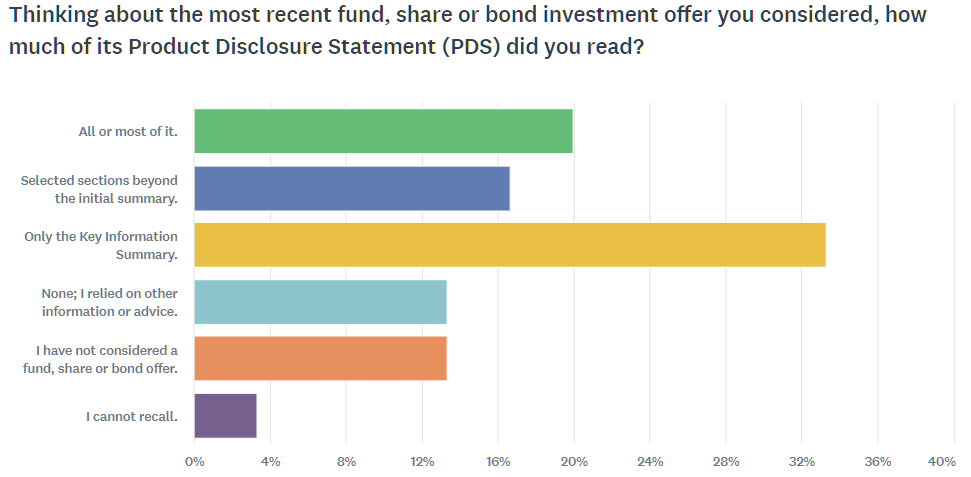
Note that:
- 10 respondents viewed the Key Information Summary only.
- 6 respondents utilised the entire PDS
- 5 respondents viewed selected sections
- 4 respondents did not look at the PDS at all, utilising other resources as an alternative.
- 1 could not recall.
The responses note that even for experienced investors, the full prescribed-form PDS is of limited use, with 76% of those making an investment decision (25 out of the 30) looking for specific information or at other sources.
This implies that PDS reform could rely on information accessibility as a key premise, with simpler disclosure documentation cross-referencing to specific “sub-documents” held on the Disclose register, or other source.
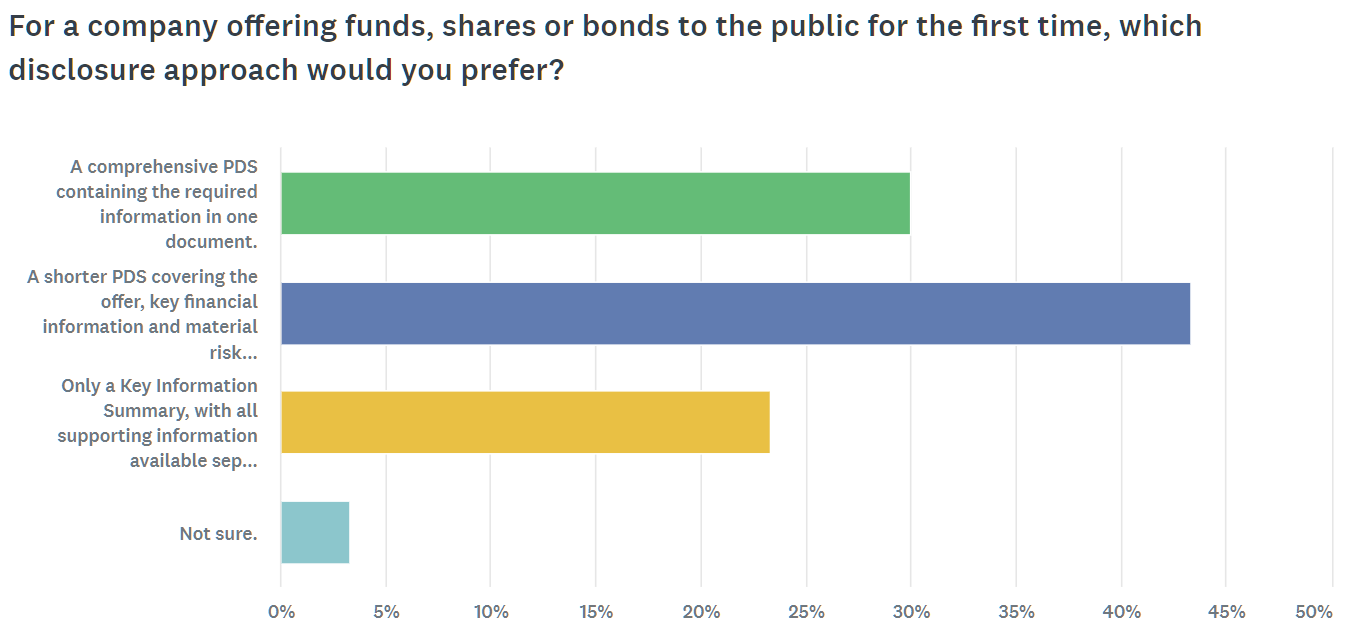
We note that the initial legislative intent was for PDS to be easily understood by retail investors (‘a prudent but non-expert person’), rather than investment professionals. A simplified PDS featuring a Key Information Summary, sections on key financial information and risks, with links to other supporting (external) documentation would appear to be favoured by nearly half of survey respondents:
1.3Do you agree with the problem definition in relation to the PDS? Which, to you, are the most pressing issues to be addressed?
Yes.
- We would add that the prescribed format of the PDS has led to a “compliance-first” culture to PDS development, which has unwittingly overcome the intention to prepare a document useful for retail investors.
- We agree with s.55 bullet 5 in the consultation document, that the PDS regulatory regime ‘defaults’ to a printed form, and notes a ‘digital-first’ approach as a solution. NZSA believes that a significant portion of retail investors (38% of our survey respondents) are also using AI in support of their investment decisions. This is likely to be higher amongst younger investors.
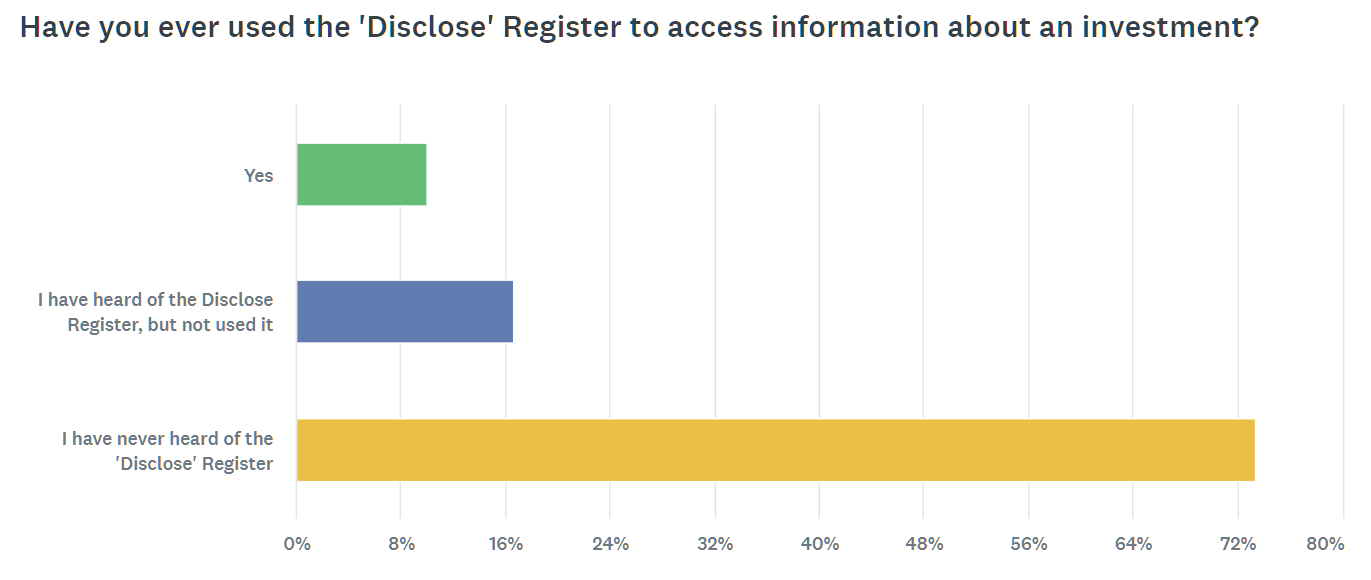
- NZSA believes that the poor awareness amongst retail investors of the Disclose register, and the poor experience it offers, form a significant barrier to effective use of ‘cross-referencing; within a PDS. Disclose should be part of the solution as a ‘single source of truth’ for cross-referenced documents, however is generally not used by retail investors (see below). In our ‘flash’ survey, only 27% of experienced retail investors are aware of Disclose, with only 10% having used it.
- NZSA supports further investment in Disclose, to become a comprehensive knowledge repository for key documents associated with a greater range of financial products than it currently serves. A single source of truth is likely to increase in importance as digital referencing becomes more common.
1.4Do you know of companies which have considered listing financial products (including on NZX) that have chosen not to do so, where the PDS requirements were part of that decision? Or which have made wholesale-only offers to avoid the costs and delays of PDS?
Not directly as a result of PDS – as noted in section 0.10, NZSA does not believe that simplified PDS in its own right acts as a ‘silver bullet’ to encourage financial product listings.
Wea re aware of companies that have considered a listing among other options, but have pursued alternative strategies as a result of wider compliance burdens, market timing, perceived onerous legislative requirements and other issues.
1.5Do you think the current PDS requirements could be reduced without compromising retail investor confidence and protections?
Yes.
75% of our survey respondents noted the following items as key priorities within a PDS:
- Price, key dates and how to participate in an offer
- What the proceeds of the offer will be used for
- Financial information
- Directors, management ownership and related-party interests
This latter point is interesting in the context of NZSA comments made in section 0.7, related to the high degree of concentrated ownership structures on NZX.
NZSA notes some of the “freeform” comments in its survey:
“There must be significant cost in preparing these documents, they may meet a compliance obligation but are often not helpful for investors.”
“Often it is unclear what events or actions could materially affect the organization raising funds”
“The restriction on word limits has rendered these statements virtually useless.”
1.6Which of the preliminary options do you support for further development, and why?
If you support B, which sub-option do you support?
If you support C, which sections would you remove or reduce and/or, which instruments do you think it should apply to (such as the debt to overseas investors scenario or other specific types of offers)?
NZSA supports B, C and E as options for PDS simplification.
B: NZSA believes that Option i (removing specific sections) to simplify the PDS would offer a significantly simplified document for investors and offerors alike.
We believe that this change should be supported by investment in the Disclose Register, a review of its scope and relationship to investor-relevant documents filed on the Companies Register or relevant Exchange websites.
C: NZSA supports Option ii (Remove the PDS requirement and introduce a simple ‘term sheet’ offer for offers of same or prior ranking debt or equity) as an alternative to a simplified disclosure PDS, on the basis that material information relevant to the offeror is already known to the market.
We also consider that Option C(ii) may be relevant for an NZX-listed company with equity securities considering an offer of listed Debt Securities. As noted in section 0.8, NZSA considers development of the NZDX an opportunity for New Zealand investors.
1.7If the full PDS were reduced, which parts do you think are most important to retain?
See our response in section 1.5.
Compared with the current regime, this would focus a PDS to
- Key Information Summary
- Purpose of the Offer
- Key dates and Offer process
- Financial Information
- [new] Directors, management ownership and related-party interests
- Inclusion of links to material information to Disclose and/or external websites
We believe that other sections may still offer relevance, but can be accessed via hyperlinks to key documents in the Disclose register and (for an NZX, USX or Catalist listed company), to the company’s latest Annual Report on the relevant exchange website.
This approach may also make more information visible to potential investors, at the discretion of the company rather than by prescription. For example, an offeror may choose to provide hyperlinks to key governance documents (Board Charter, Audit Committee Charter) or investor presentations.
1.8Do you think the adaptation of the PDS requirements to a ‘digital-first’ format should be a government priority? Do you know of examples in other jurisdictions?
Yes.
In addition, NZSA believes that strengthening awareness and experience of the Disclose Register becomes more important in the context of a world becoming more enabled by the use of AI. Even a digital-first format may not be “read” by a human investor, but by the AI engine providing information to the user.
A trusted register and/or source of information, recognised as such by trained AI, will become more important in this context.
We note developments in Australia in promoting a digital-disclosure approach to PDS, although we acknowledge this is unlikely to be considered “digital first”.
1.9In your experience, what requirements in the Act and Regulations are preventing the PDS from being more digital friendly? How much regulatory change would be needed?
The major barrier to ‘digital first’ PDS is likely to be the level of prescription.
NZSA believes that a principles or policy-based regime is likely to provide greater scope for both content and the means by which that is presented.
Regulations: The current regulations prescribe structure, headings and order – none of which are suited to menu-based navigation. The use of prescribed formats may restrict the use of graphics or interactive digital mechanisms that would otherwise help the user understand the offer.
NZSA notes that regulations for a digital-first format should provide:
- Explicit allowance for “layered” disclosure and navigation
- Version history
- A data record: explicit investor acceptance that they have received the data
Role of Disclose: A ‘holistic’ approach to digital development of PDS should also include a concurrent ‘digital first’ approach to Disclose, supporting the connection between digitised PDS, investor accessibility and government support/investment in trusted capital markets. Lodgement and Publishing capabilities need to support any move to digital.
1.10If you have experience making financial offers digital friendly, how have you done this (app, website, portal, etc.) and how have you managed this while still meeting PDS requirements?
n/a. NZSA does not create or advise on financial offers.
1.11Are there overseas models of PDS that you think the Government should consider?
Australia has adopted a digital-friendly format within its requirements that has allowed some concessions to prospectus rules.
We also note reforms via the UK’s Consumer Composite Investments regime. This is intended to improve consumer investment disclosures, with full implementation from 8 June 2027, significantly reducing the level of prescription and allowing greater design freedom. NZSA recognises that this scheme has a different scope to IPO disclosure requirements.
1.12Please share any other comments, evidence or data you have on PDS requirements.
NZSA sent this position paper on PDS to MBIE during December 2025. We believe this maintains relevance for this submission.
2. Civil liabilities for directors and issuers
2.1Do you agree with the problem definition around current settings for director liabilities? Please provide evidence or examples.
Broadly, yes.
NZSA wishes director liability settings to strike an appropriate balance between taking measured risks in pursuit of investor return, and prudence in the stewardship they provide over shareholder funds.
As the consultation paper suggests, NZSA is wary of the ‘compliance trap’, which results in a strong focus on compliance rather than corporate strategy.
NZSA also notes the current review of directors’ duties being undertaken by the Law Commission. We believe that director liability settings should be considered in the context of the outcomes of this review. For example, we would not wish to see both a reduction in the duty of care expected by Directors under s.137 and a reduced liability for contraventions.
2.2How significant are civil liability settings compared with other factors affecting public market participation, such as market depth, liquidity, access to private capital, listing costs, ongoing compliance costs, and broader economic conditions?
NZSA is unable to comment on this question.
Ultimately, NZSA wishes to see a healthy capital market in New Zealand that provides opportunities for investors, and a pathway for domestic companies. We note the change to the Australian liability settings as set out in paragraph 91 of the consultation document.
2.3Which option do you support (A or B) for potential change to liability in relation to continuous disclosure contravention for directors and other persons? Please indicate a preferred sub-option as well if relevant. Please give your main reasons.
NZSA supports Option B (i) to narrow the requirements to be “involved” in a contravention. NZSA believes this will best balance ongoing investor protection with a reduction in the individual risk faced by Directors. We intend the behavioural outcome to be an improvement in strategic assessment by Directors, with an improved focus on balanced risk-raking that is in the best long-term interests of the company.
However, we also believe that the speed and depth of enforcement action by the Financial Markets Authority (or other relevant enforcement bodies) should be improved to ensure that accountability on behalf of investors is pursued in a timely fashion
We include some of the comments below from our survey respondents supporting a reduction in the liability risk faced by individual directors:
“There needs to be a balance because we don’t want to discourage the most diligent and competent directors. It is too hazardous for directors with the current settings.”
“Tight regulation on a director ensures they are not on too many companies and that they are more careful about what they are backing”
“There has to be an “out” for circumstances beyond a reasonable director’s control or the pool of available competent directors will decline.”
Some commentary noted poor confidence in the ability of regulators to “call directors to account”.
“Regulators need to have resources & funding or else they have no teeth.”
2.4Do you have a preference not reflected in the options in relation to continuous disclosure contravention for directors and other persons?
NZSA has no further comment to make as to potential other options.
2.5Are there any other issues or impacts the Government should consider in relation to liability for continuous disclosure contraventions for directors and other persons?
NZSA notes that NZ RegCo brings a “first line of defence” for NZX investors, with NZ RegCo referring market conduct incidents to the FMA for further investigation.
As noted in section 2.3, NZSA would support and review/action to support timely and effective enforcement action by the FMA, to ensure that those contravening disclosure standards are held to account. This could include consideration of additional statutory enforcement powers for NZ RegCo in its own right, for certain disclosure breaches, as a means of adding enforcement resources.
2.6Which option do you support (C or D) for potential change to liability in relation to continuous disclosure contravention for issuers? Please indicate a preferred sub-option as well if relevant. Please give your main reasons.
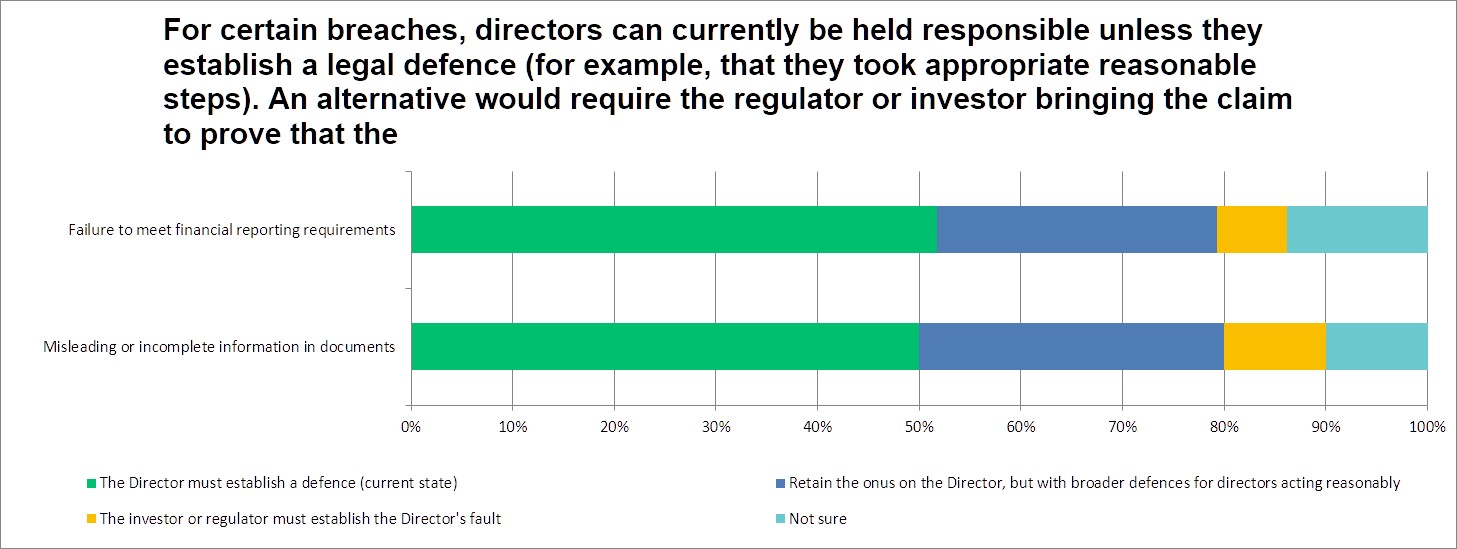
NZSA observes significant investor nervousness at moving to a fault-based standard for issuers and their directors, which places the onus on investors or the regulator to prove fault. This is likely due to the information imbalance inherent in the relationship between shareholders and representatives of the issuer.
The gauge below is taken from our survey. Note that ‘50’ represents no change in investor confidence.
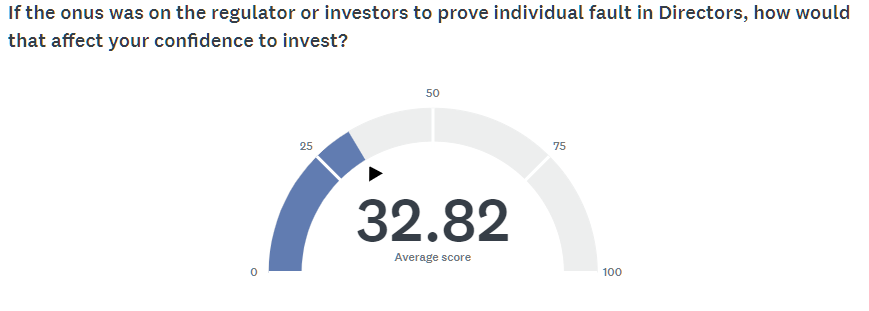
The response does show that some caution is warranted in balancing the settings between the individual risk faced by directors (section 2.3) and the accountability faced by the issuer. Overall, there is a likely inverse relationship between director and issuer liability, and investor confidence in markets.
Nonetheless, NZSA recognises New Zealand’s current competitive disadvantage compared with other jurisdictions; we still wish NZ investors to have a market to invest in.
On this basis, NZSA cautiously supports some change to the current settings related to issuer liability, although with a preference on D (iv) to adjust the statutory defences available to issuers, rather than a wholesale move to a fault-based regime.
We also note that the actions and rules of individual licensed exchanges (NZX, Catalist) also play a role. As we have noted previously, there is no ‘silver bullet’ to improving capital markets. NZSA might be more willing to support a move to broader fault-based liability for new issuances, as per D (iii), should strict liability for continuous disclosure be retained within the NZX Listing Rules.
2.7Do you have a preference not reflected in the options in relation to continuous disclosure contravention for issuers?
Not specifically, although please note our comments in section 2.6.
2.8Are there any other issues or impacts the Government should consider in relation to liability for continuous disclosure contraventions for issuers?
NZSA has no further comment to make as to potential other considerations.
2.9Do you think changes to deemed director liability should be considered in relation to all markets, or for NZX only?
NZSA believes that the core principles applicable to market issues should be determined primarily by company-based thresholds relating to size, number of shareholders, and other metrics relevant for investors (see our comments in section 0.2 and 0.5).
On this basis, we would prefer a deemed liability regime applicable to all companies facing continuous or event-based disclosure, regardless of listing status.
2.10Which option do you support (E, F, or G) for potential change to deemed director liability? Please indicate a preferred sub-option as well if relevant. Please give your main reasons.
NZSA supports Option F as expressed in the consultation document.
As noted in section 2.6, our survey respondents had some misgivings with a move to a fault-based liability regime (as per Option G), while simultaneously expressing concern that the existing liability regime was too onerous to support new listings and new director development.
2.11Do you have a preference not reflected in the options in relation to deemed director liability?
NZSA has no further comment to make as to potential other options.
2.12Do you have other comments on what the Government should consider in relation to deemed director liability?
NZSA has no further comment to make as to potential other considerations.
2.13Are there international models you would like the Government to consider?
NZSA has noted elsewhere in this submission that New Zealand markets benefits from high levels of trust, created in part by strong investor protections. Our overall submission reflects a practical balance between maintaining investor confidence while ensuring market opportunity and capital markets growth.
This also reflects a required balance between global alignment and pragmatic ‘New Zealand’ solutions that overcome systemic issues (eg, scale) while offering competitive opportunity (eg, market flexibility).
While Australia is a very relevant market to compare ourselves against, NZSA believes that ultimately, the optimal outcomes will be a very ‘New Zealand’ solution, creating competitive advantage for New Zealand companies and investors alike.
2.14Please share any other comments, evidence or data you have on civil liabilities.
NZSA has no further comment.
3. Catalist market threshold and audit requirements
3.1Do you think Catalist’s current entry threshold (below $60 million market capitalisation) and exit threshold (two years after reaching $100 million market capitalisation) are still appropriate, having regard to its intended role and purpose? Please explain.
Thresholds: In general, NZSA supports the development of company-based thresholds to support disclosure and other compliance requirements, regardless of listing status, rather than applying thresholds to specific markets. We consider this supports competition for capital (and listings) regardless of listing platform.
In response to this specific question, NZSA agrees that a review of entry and exit market capitalisation thresholds for any licensed market (including Catalist) is warranted. From the options in the consultation paper, we are supportive of Option C. (removing the entry threshold, with a raised exit threshold).
Those same thresholds should also apply to segmentation rules within existing markets to avoid regulatory arbitrage. We note the NZX proposal to establish exemptions to listing rules for smaller issuers; whichever threshold is determined as the Catalist ‘exit’ point should also apply to NZX’s SME regime.
Unlicensed Markets: However, to avoid regulatory arbitrage, we also believe that the exemption currently applied to allow unlicensed product markets should be removed.
Specifically, NZSA supports removal of the exemption currently applied to USX. USX currently operates as an unlicensed trading platform under an exemption from Part 5, subpart 7 of the FMCA. Removing the exemption would require the market to be licensed by the FMA to operate as a licensed exchange.
We note that at least 2 businesses (Just Life Group and Geneva Finance) have delisted from NZX recently, with both establishing listings on USX rather than Catalist. This implies that a ‘step up/ step down’ process has the power to be successful, but the market has responded by applying regulatory arbitrage between the trading platforms on offer.
While USX has listing rules, it also has limited enforcement capability to enforce those rules. Unlike Catalist, USX is not subject to any threshold tests in terms of market capitalisation. Catalist is also subject to FMA Review of its market obligations. Even if total listing costs for either platform were the same for issuers, NZSA believes that the settings applicable to Catalist as a licensed exchange offer greater protection for investors.
NZSA supports competition for both capital and trading platforms, but also believes that competition should occur on the basis of a level playing field within the same proportionate risk settings.
3.2Do you consider that the original policy rationale for Catalist—as a stepping-stone market addressing a funding gap for small growth companies raising $2-20 million—should be expanded? If so, what types of issuers or needs should Catalist be designed to support, and why do you consider the associated regulatory concessions remain justified?
We believe the policy rationale remains sound, and that even if market capitalisation thresholds are increased, capital raising ability should remain more limited. We would support an increase in the capital raise thresholds linked to inflation.
Again, however, we would prefer any such capital raise thresholds to be based on company thresholds regardless of listing status or listing platform. This may encourage greater use of different market options for issuers, whether listed on a different exchange or having no listing status.
3.3If you support change, which option do you prefer and why? How do you think your preferred option would affect businesses considering listing on Catalist, businesses currently listed on NZX, and investors?
Investors: Regardless of listing platform, NZSA believes investors would benefit from reduced costs associated with proportionate compliance settings in proportion to company size. Together with changes to disclosure settings and director liability, this is likely to increase listed investment opportunities in the longer-term.
Catalist: NZSA does not believe that a change to market capitalisation setting, in and of itself, will dramatically increase IPOs or new listings on Catalist.
The presence of USX, a viable trading platform competitor to Catalist with a much lower regulatory threshold and oversight, will continue to dampen demand for Catalist listings.
We also note the NZX current consultation on introducing exemptions to their listing rules for small-to-medium enterprises. This is also a form of proportionate compliance, that may reduce demand for smaller NZX listings to transfer to Catalist.
NZX: Changes to Catalist listing and capital raise thresholds could mean a reduction in smaller IPOs (such as that for Taiko Critical Minerals in early 2026). On the other hand, the lack of a “lower limit” for NZX coupled with proposed changes to NZX listing rules for smaller issuers (see above) could see better retention of existing NZX listings.
3.4How would changing the thresholds affect Catalist’s role relative to NZX and the wider capital market pathways and options for growing businesses?
See comments in section 3.3.
We believe that an increase in market capitalisation thresholds, and competition between market platforms on a level playing field, acts to support a wider variety of capital market pathways for New Zealand businesses.
While introducing company-based thresholds for compliance requirements would provide a baseline for all companies (regardless of market), individual markets may choose to establish additional compliance requirements within their Rules, depending on their own commercial imperatives.
3.5If thresholds are changed, should any additional safeguards or conditions apply to manage risks (such as regulatory arbitrage or reduced investor confidence)? If so, what should they be?
As noted in section 3.1, we believe exemption currently applied to USX under Part 5, subpart 7 of the FMCA should be removed.
3.6Do you think the FMA should consider amending the exemption notice that enables businesses listed on Catalist to raise up to $2 million without a product disclosure statement, if the crowdfunding and peer-to-peer lending limits with which the exemption notice aligns are raised (see issue 5)?
Yes.
As noted above, NZSA supports a proportionate regime based on company thresholds, applying equally to all markets. Should the limits applying to crowdfunding thresholds be increased, those same limits should be applied within a licensed market.
3.7Which option do you prefer in relation to audit requirement standards? If you agree with the removal of the IFRS Tier 2 requirements, what standard should apply instead?
NZSA considers that financial reporting and assurance requirements should be considered separately.
Reporting: We believe that the financial reporting standards determined by the XRB should continue to be applied; ie, we do not support a change to the existing Tier 2 reporting standards required of Catalist issuers. This provides consistency, clarity and comparability for users of financial statements. In line with the core principle of company-based thresholds we have outlined in this submission, Tier 2 reporting should also be applied to any company meeting the threshold in any exchange (including smaller issuers on NZX). This would require consideration of public accountability criteria.
Assurance: NZSA supports a company size-based threshold in relation to audit and assurance requirements, regardless of listing platform or status (ie applicable to smaller issuers on the NZX also). In practice, this may be a combination of total assets and/or total revenue (as per the thresholds in the Financial Reporting Act), and shareholder numbers (on a look-through basis) as a further determinant.
Application of thresholds to a wide scope would reduce the regulatory arbitrage for smaller issuers between a licensed exchange and the private market.
If the reform proposal is to focus only on those companies that are listed on a trading platform, NZSA prefers a combination of market capitalisation and shareholder numbers (on a look-through basis) as key determinants.
Those thresholds then determine whether a company is required to undertake an audit (‘reasonable assurance), a review (‘limited assurance) or no review of financial statements.
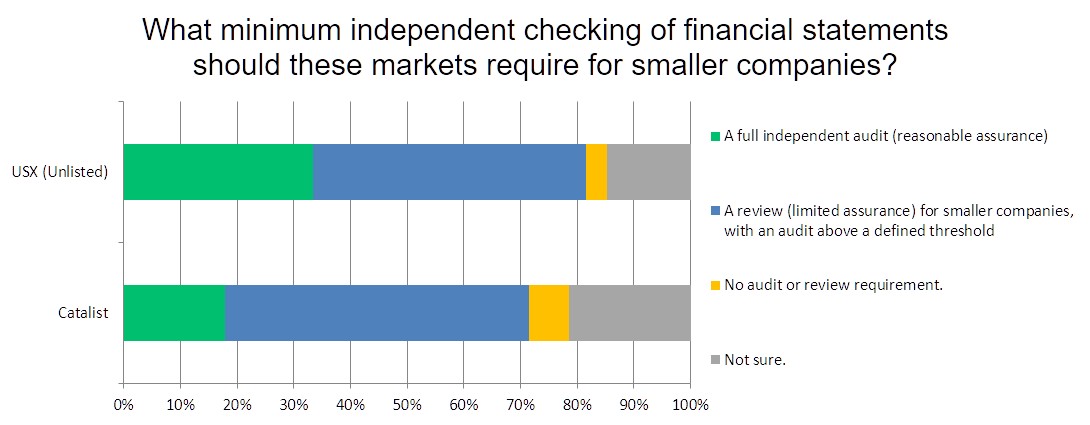
Our survey responses indicated that largest single response group of investors would be happy for a limited assurance review standard to be applied to smaller issuers on both Catalist and USX.
3.8If you agree that some businesses should not be required to produce audited accounts prior to initial listing on Catalist, which firms should that apply to (eg, all, or only a specific size measured by number of investors, or shareholders, or voting shareholders)?
See our comments in section 3.7.
If the reform proposal is to focus only on those companies that are listed on a trading platform, NZSA prefers a combination of market capitalisation and shareholder numbers (on a look-through basis) as key determinants.
3.9Please share any other comments, evidence or data you have on changes to Catalist settings.
NZSA has no further comments at this time.
4. USX audit requirements
4.1Do you think USX’s current audit requirements are proportionate for the type of market USX operates and the issuers that use it? Please explain.
No.
NZSA notes the wide variety of companies listed on USX, with the largest having a market capitalisation of $850m. In the absence of clear company thresholds and/or market capitalisation thresholds applicable to USX, it is difficult to determine appropriate proportionality requirements specific to USX.
Offerings listed on USX are retail investment products, without any of the protections normally expected on a retail-led exchange.
As noted in section 0.5, and at various points throughout our submission, NZSA supports the development of company-based thresholds to support disclosure and other compliance requirements, regardless of listing status, rather than applying thresholds to specific markets.
In relation to audit requirements, please see our comments in section 3.7 above, and the associated survey response. This indicated that i most investors would be happy for a limited assurance review standard to be applied to smaller issuers on both Catalist and USX, with issuers over defined thresholds warranting a full audit (‘reasonable assurance’).
Given that USX has no exit threshold, we would expect that some issuers on USX would continue to require a full audit, a possibly relevant factor in the higher response for USX than Catalist preferring USX companies to maintain a full audit.
4.2If you support change for USX, which option do you prefer? Why?
We would prefer Option ‘B’, but with thresholds based on the Financial Reporting Act associated with total assets and / or total revenue. We believe that this promotes regulatory consistency. Furthermore, as per our comments in section .7 above, NZSA believes that total shareholder numbers (on a look-through basis) should also form a determinant as to whether an audit or limited assurance review forms the basis for compliance.
We believe whichever thresholds are adopted, they should be applied equally across all markets and trading platforms, as well as to relevant companies that are not listed.
4.3If an External Review Board review engagement were allowed for some USX issuers, what criteria should determine eligibility? For example, should this depend on issuer size, shareholder numbers, annual fundraising, trading activity or something else?
See our response in sections 3.7, 3.8 and 4.2.
We consider that broadening the remit to include non-listed companies would reduce the regulatory arbitrage for smaller issuers between a licensed exchange and the private market.
If the reform proposal is to focus only on those companies that are listed, NZSA prefers a combination of market capitalisation and shareholder numbers (on a look-through basis) as key determinants.
4.4If audit requirements are reduced for some USX issuers, should the same criteria also apply on Catalist? Why or why not?
Yes.
NZSA encourage competition between market providers, on a level playing field within the same proportionate risk profile.
4.5What broader evidence or practical examples should the Government consider when assessing whether current audit requirements are affecting issuer participation, investor confidence, or the role of smaller markets more generally?
NZSA is unable to provide further comment.
4.6Please share any other comments, evidence or data you have on USX settings.
Please note our comments in section 3.1 supporting the removal of the exemption issued to USX under Part 5, subpart 7 of the FMCA. We believe that companies within the same proportionate risk envelope are applying regulatory arbitrage between licensed exchanges (such as Catalist) and USX. The trade-off between the two is investor protection.
5. Crowdfunding and peer-to-peer lending limits
5.1Do you think the current aggregate $2 million capital-raising limit should be increased for equity crowdfunding and P2P lending? If yes, please discuss why you think it should change (eg, any practical constraints you think the current cap creates and how a higher limit might change the way businesses use crowdfunding or peer-to-peer lending).
NZSA does believe the cap on capital raising and/or P2P lending should increase to better reflect settings in overseas jurisdictions. The level of the cap should also be conscious of the equity pathway offered to issuers via a licensed exchange for small issuers (such as Catalist).
We consider a cap of $5m in fundraising for each of equity or debt with a 12 month period (Option C) appropriate in light of our submission made in section 3.2 and to align with the Australian equity limit.
However, any significant change in the cap should also be accompanied by individual investor threshold limits, to act as a blunt form of investor protection in the absence of the protections offered under retail offers.
- We note that crowdfunding is designed to make it easy for retail investors to invest, we believe an individual investor threshold is particularly important in this context. This is despite the riskier nature of typical underlying investments, that tend to have more in common with wholesale investment than retail.
- We also note the limited liquidity associated with shares issued under crowdfunding offers, although this may change if crowdfunding offers are able to be made by companies listed on Catalist or NZX.
Again, to align with Australia, we consider a $10,000 individual investor limit with a 12 month period appropriate (Option E) within each company seeking crowdfunding equity and/or P2P.
If an individual investor limit is not in place, NZSA does not believe the threshold should change at all (Option A).
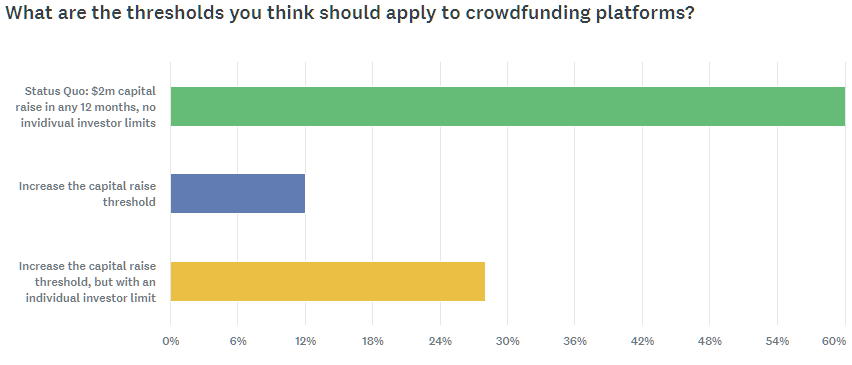
Interestingly, our survey responses indicated some caution around existing crowdfunding thresholds, as shown below. This may incentivise issuers seeking crowdfunding to provide more fulsome information as a means of enhancing wider investor confidence, and for platforms to develop enhanced protections than the is currently on offer.
5.2If the “small offers” category is removed from the aggregate, what limit do you think should apply to it separately?
NZSA believes that small offers should remain within the aggregate applied to crowdfunding.
5.3Which option (A-D) do you support and why? If there are variables within the option, please be as specific as possible. (For example, if you support option B to raise the limit, please say what you think the new aggregate limit should be and why; if you support option C, please say what you think the separate limits should be.)
See our response to section 5.1
5.4If you support Option D, do you have suggestions for how requirements could be tiered?
NZSA supports the introduction of company-based thresholds, as we have noted many times throughout this submission.
However, we do not consider that any specific thresholds should be applied specifically to crowdfunding offers, and therefore do not consider Option D viable.
The preferred threshold determinants (total revenue, total assets and shareholder numbers) proposed by NZSA earlier in this document would apply to companies regardless of their listing status.
Once a company that has raised capital via a crowdfunding platform exceeds those thresholds, but has remained unlisted, this would offer a proportionate degree of protection to investors (such as a limited assurance review), while perhaps encouraging a listing on a licensed exchange, if only to facilitate secondary share trading amongst its shareholders.
5.5If you support option E (an investor cap), how do you think that could be designed? Are there any other additional safeguards and retail investor protections you think should apply for larger raises?
As noted in section 5.1, NZSA supports the introduction of an individual investor cap in the context of increased equity crowdfunding and P2P lending limits.
- NZSA does not consider that equity raises beyond the thresholds set out in section 5.1 should be undertaken via crowdfunding platforms. Conversely, in the context of an investor cap, we consider that a single regulatory toolkit can be applied to all crowdfunding offers.
- Larger capital-raising offers beyond crowdfunding thresholds proposed above have an alterbnative equity pathway via a licensed exchange (Catalist or NZX).
- NZSA considers that a common investor identifier could help monitor compliance with an crowdfunding individual investment limit.
- Existing Common Shareholder Numbers (CSNs) could support the design, but do not themselves provide a complete cross-platform record of crowdfunding or P2P investments.
- Any system would require appropriate data sharing, identity matching and look-through treatment of nominee or custodial holdings
5.6If the cap is raised, what flow-on impacts do you foresee on other capital markets?
NZSA believes there will be little impact on other markets in the short term. In the longer-term, we believe that changes in capital raise limits will fuel greater growth opportunity and ultimately offer further opportunities for listings on licensed exchanges.
5.7Please share any other comments, evidence or data you have on equity crowdfunding, P2P lending and ‘small offers’.
NZSA is unable to make additional comments.
5.8Are there overseas models you think the government should consider?
NZSA notes that thresholds applicable within Australia as per the consultation document.
6. Wholesale investor issues
6.1Do you have any evidence or experience of difficulties around the use of the eligible investor self-certification, or misuse of the self-certification approach? Please provide detail.
NZSA has no direct evidence of misuse of self-certification, but has noted recent commentaries relating to Du Val Group. We have also witnessed a shareholder at a USX-listed company meeting with the purpose of approving a wholesale capital raise comment to all shareholders that he “had helped many people qualify to be a wholesale investor”, “it wasn’t that hard”, and he was “happy to support (and certify) any [company] shareholder who wanted to participate as a wholesale investor”.
NZSA considers this a somewhat laissez-faire approach to the requirements of a certifier.
In a recent article (October 2025), NZSA supported the intent of self-certification and the eligible investor pathway. This creates better accessibility for knowledgeable investors to wholesale offers than in many other jurisdictions. We also noted that a wholesale investor defined by a wealth threshold at least allowed an investor to seek financial advice and other expert opinion.
However, we remained concerned at:
- The lack of enforcement surrounding both confirmers and offerors in the self-certification pathway. The process is characterised by a ‘high-trust’ model from the Regulator and some confirmers.
- The conduct of wholesale offerors when it comes to advertising wholesale offers via social media or mass-circulation newspapers
- The recent ‘Fitzgerald’ case outcomes, which clarified “negative assurance” as the assurance role of the confirmer. This means that confirmers don’t have to verify the sophistication of the investor, merely to ensure the investor has been sufficiently advised of the consequences of certification, and that there is no reason to believe the self-certification is incorrect.
6.2Do you consider that the wholesale investor regulatory framework provides adequate retail investor protections? Or do you consider that it presents a barrier to investment?
No. We also believe that it should not do so.
We also do not believe that the requirements of the regime present an undue barrier to investment. As per our comments above, we believe that retail investors who do not meet other thresholds for wholesale investment are still able to access wholesale investment products as an eligible investor, based on knowledge and / or relevant skills related to financial products. We consider this an appropriate and accessible scheme, particularly when compared with other jurisdictions.
However, we believe that more substantial enforcement of confirmers and conduct of offerors (particularly as regards advertising) is required to better balance investor protections with the intent of the regime.
NZSA accepts that a longer period of eligibility for wholesale eligible investor certificates may reduce costs and bureaucracy for eligible investors. However, we also believe this is unlikely to restrict capital flows into wholesale offers.
6.3Which option for change in relation to the wholesale eligible investor certification would you support (noting that the options are not mutually exclusive).
NZSA would support Option A (Develop more objective ‘experience’ definitions for an eligible investor) and Option C (Role and consequences under the Act for professional confirmer) as a significant improvement to the current eligible investor regime.
- Defining the experience required to determine a level of sophistication would support the intention of the eligible investor regime and clarify the experience requirements.
- A legislative focus on the confirmer would resolve confusion and/or unintended consequence arising from the recent Fitzgerald decision.
Note that NZSA does not support option B. Prescription would result in higher assessment costs, act as a barrier to investment flows and heightens the risk of a ‘compliance culture’ rather than a focus on the investors’ underlying capability.
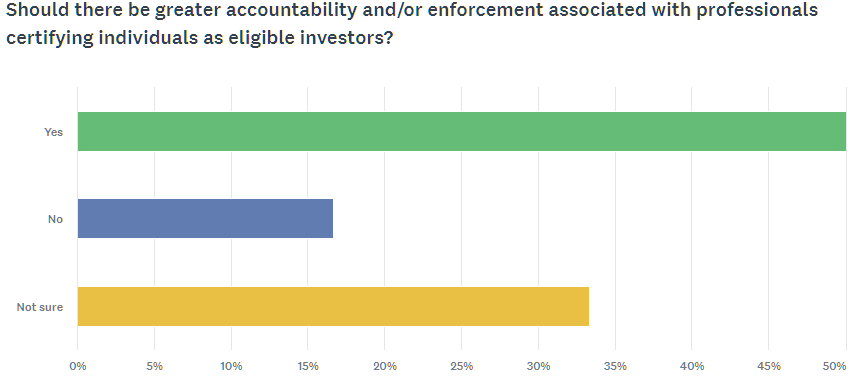
50% of our survey respondents favoured an approach of greater accountability for confirmers, and stronger enforcement.
6.4Which option do you prefer in relation to the period of validity for eligible investor certificates (currently 2 years)?
NZSA supports Option F, recognising that different eligible investor certificates are still required for different investment offers.
6.5Do you have any evidence or experience of concerning behaviours with the advertising of wholesale offers? What recommendations do you have for restricting this promotion?
Yes.
NZSA has made a previous submission (via the FMA in May 2021) highlighting issues with the conduct of wholesale offerors as regards advertising in mass circulation newspapers and social media, with limited fine print or fine print too small to read explaining the wholesale offer.
This image of a print newspaper advertisement dates from May 2021, but is typical of the nature of advertised wholesale offers.

NZSA survey respondents noted that advertising should be allowed, but with prominent warnings relating to eligibility requirements and reduced investor protection.
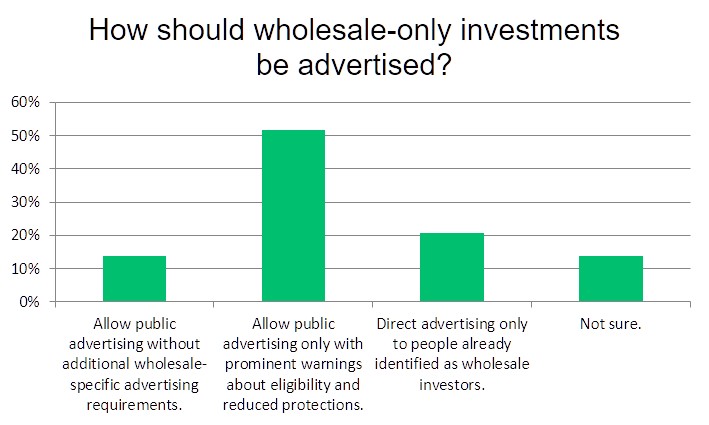
6.6Do you have concerns with other aspects of the wholesale regime (beyond eligible investor category and the promotion issues raised)? Do you think the $750,000 threshold for individual investment remains appropriate, or should it be adjusted?
NZSA believes that the $750,000 minimum investment threshold should be revised upwards, accounting for inflation at least. This is a transaction-based threshold, not a test of total wealth. The ability of an investor to make a large investment alone does not account for investor sophistication, nor the ability to support a loss. However, the threshold does at least imply a degree of wealth that allows potential wholesale investors to seek appropriate expert advice.
We agree with the sentiment articulated in paragraph 200 of the consultation paper.
6.7Please share any other comments, evidence or data you may have on wholesale settings.
We have reflected below some of the “freeform” comments received in our September 2026 survey:
On ‘pushing boundaries’ and providing information to participants about a wholesale offer:
“I went to a local presentation last year where the business group were promoting an opportunity that was very much for wholesale-only investors. Yet in the room there were several people who did not understand wholesale investment or what it meant because the meeting advertising was poorly done. Wholesale investment was not explained properly to attendees and it was obvious the promoters of the new resthome were pushing the boundaries by limited notices in their advertising. All up, it was a shocking example of how people can push the boundaries.”
“Personally, I use any requirement for wholesale investor status to participate in an opportunity as a helpful black flag for my involvement.”
On confirmer accountability:
“Those professionals signing off on eligibility need to be held to greater account. Such professionals cannot have any conflict of interest with the offering.”
On advertising:
“In [advertising requirements], the word prominent is MOST important”
A couple of survey respondents also stated that all investors should be able to access wholesale opportunities proportionate to their wealth, with no eligible investor pathway. This is not a position supported by NZSA, as we believe it would require wealth certification / evidence for every wholesale offer application, resulting in increased compliance costs.
7. Auditor liability
7.1Do you agree with the scope of this issue as outlined above (ie, limiting consideration to FMC audits and civil liability for unintentional wrongdoing)? If not, what else do you think should be considered?
Yes.
7.2Do you agree with how the problem definition is summarised above? Please provide additional information and detail if you think this needs to be refined.
NZSA agrees with the problem definition as expressed in the consultation paper. We particularly note the comments expressed in paragraph 204. In preparing for a review of its own audit policy NZSA completed a review in November 2024 that identified the following key factors relevant to the review of current audit liability settings:
- Industry structure and encouraging competition
- Auditor capability development and capacity constraints
- FMA oversight
- Audit quality (including global standards alignment)
- Audit costs and their key drivers
We also note recent issues that have surfaced systemic failures within the Australian audit industry. We do not consider this has been brought about by caps on auditor liability, but rather by a different regulatory oversight model.
We note that the ‘high-grading’ of audit firms’ client portfolios in response to capacity shortages has provided competitive opportunity for smaller audit firms, or alternatively, seen some listed issuers retain Australian-based auditors. In general, however, note that the use of an Australian auditor for a New Zealand organisation is not well-regarded by local investors.
7.3The problem definition discussion above lists a number of issues that it is contended are faced by the audit market in New Zealand. Do you agree with these? Are there other issues we should consider? To what extent are these issues caused by the liability exposure of auditors? Are there other factors that are causing these? Please provide concrete evidence and data to support your response where possible.
Audit quality: We do not consider that the introduction of a capped liability scheme, accompanied by strong oversight, will unduly impact audit quality (as suggested in paragraph 213). We assert that a key driver of audit quality and transparency is linked to strong FMA oversight, rather than liability settings.
This is supported by our survey responses, with nearly 70% of respondents wanting strong FMA oversight of auditors maintained should audit liability caps be introduced.
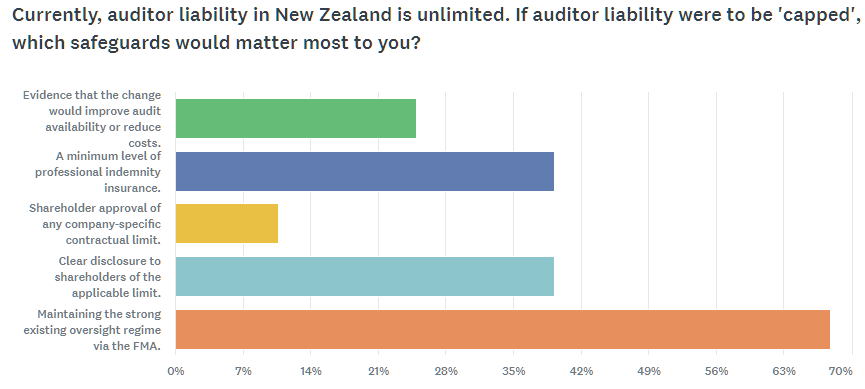
7.4Do you agree with how the options are summarised above? Are there other options we haven’t considered? Please provide additional information and detail if you think these need to be refined.
NZSA supports the options presented.
There may be further ‘sub-options’ related to Option B that could encourage other beneficial audit practices. For example, the liability cap could increase with audit firm contract tenure, encouraging more regular tendering of audit contracts.
7.5Do you have a preferred option? If so, please give your reasons for preferring it (with reference, if possible, to how it would assist addressing the issues with the audit market in New Zealand) and provide as much information as you can in support of your preference, along with any other matters we would need to take into account when designing the detail of that option.
NZSA supports Option B, with liability capped in proportion to the audit fee.
We believe this offers greater clarity to investors, rather than a negotiated outcome between the company and its auditors, and sets a common standard for companies, investors and auditors alike.
We also note that company executives are often focused on “minimising audit cost”, whereas a strong audit capability is seen as a “good cost” by investors.
7.6What are the risks associated with limiting liability for auditors in any of the ways indicated in Options B and C? For example, what would the impact on plaintiffs be? And where else might plaintiffs look to recover losses? Would audit quality suffer?
See our comments in section 7.3. NZSA does not believe there would be any impact on audit quality.
We acknowledge that a cap is likely to reduce the compensation recoverable from an auditor. Where other parties are also liable, claimants may seek recovery from them; otherwise, some losses may remain uncompensated.
7.7Do you see any issues with introducing a capping scheme just for auditors where other professions – eg, lawyers and accountants – would still be joint and severally liable for a loss where more than one party has a role?
NZSA is unable to comment on this question.
7.8Are there any other issues relating to auditor regulation and the state of the audit market in New Zealand that you would like to bring to our attention?
NZSA has no further comment. If MBIE wishes to receive our November 2024 paper referred to above, please contact NZSA.
7.9Please share any other comments, evidence or data you have on auditor liabilities or related topics.
NZSA has no further comment.
8. Broker activity and visibility of offers
8.1Do you agree with the problem definition? In your view, how significant are any issues relating to broker activity, research coverage, or issuer visibility in New Zealand capital markets, particularly for smaller listed companies? Please provide evidence or examples where possible.
NZSA agrees with the problem definition outlined in paragraphs 217-221. We believe that a lack of research is a significant factor in limiting potential IPOs on our exchanges, as well as affecting effective price discovery of shares for existing listed companies.
Our survey response indicated nearly 70% of investors wished to see more research into listed companies:
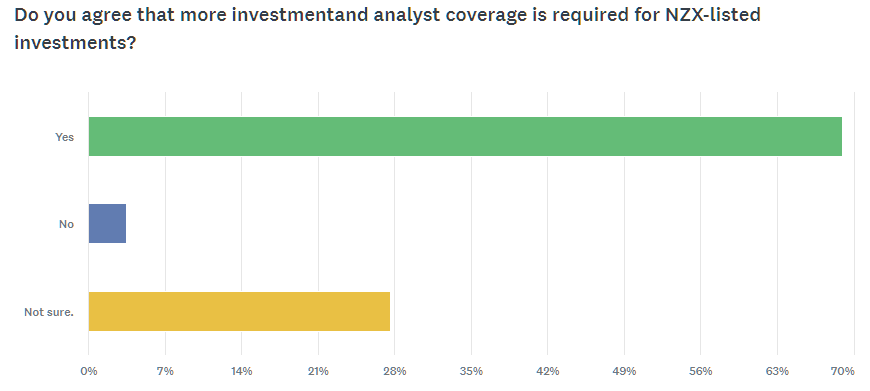
Additional considerations
We also believe that an increasing range of financial products adds further complexity to the problem statement. ‘Direct’ investment in companies continues to fall, proportionately, compared with other investment models (such as ETFs, DIMS and unlisted managed funds. NZSA estimated this trend in an August 2025 article, with the graph below showing the relative mix of investment styles since 2015.
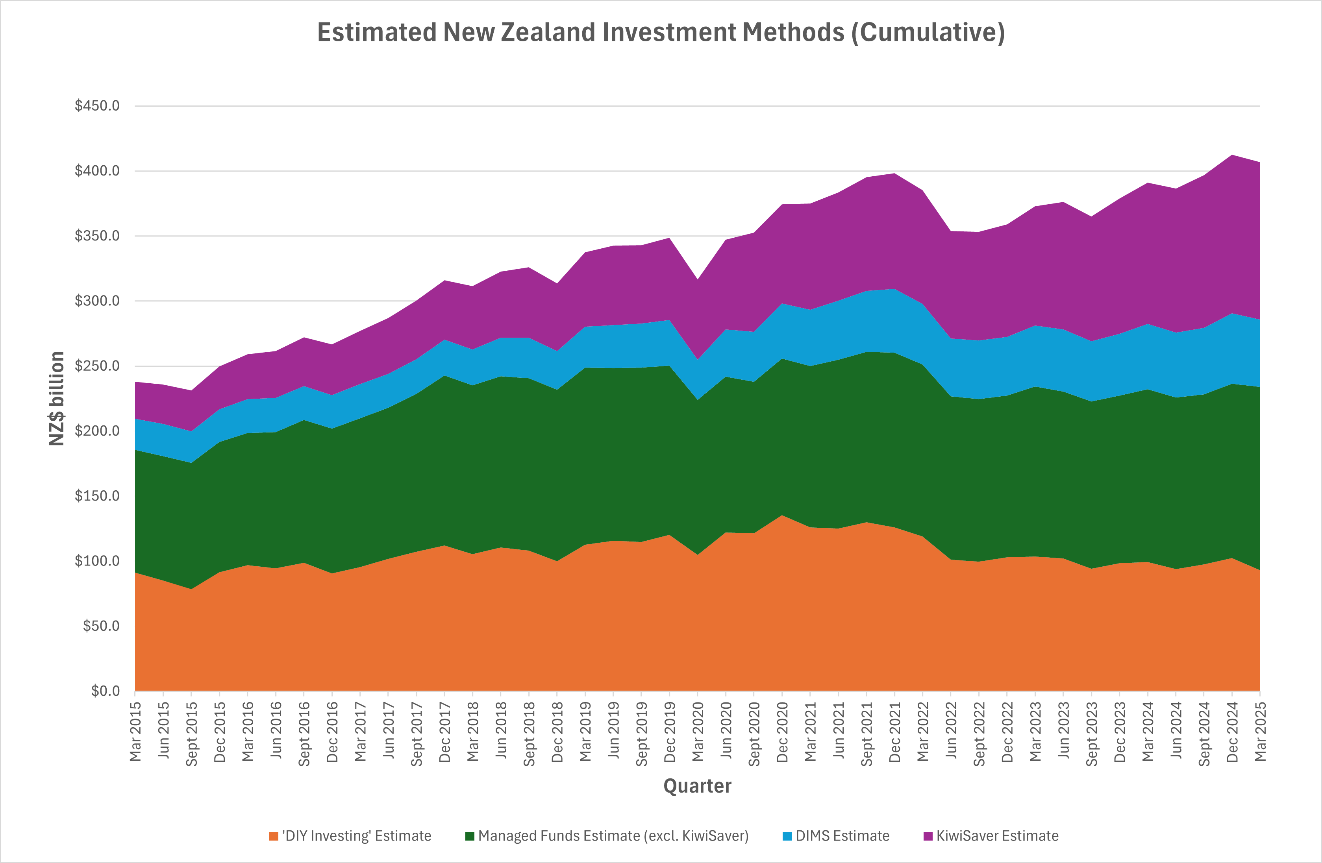
Source: Morningstar, RBNZ and Stats NZ
The rise of managed funds (active, as well as passive) has increased intermediation, and reduced levels of direct engagement that New Zealanders have with the companies that make up their investments.
We also believe that tax differentials favouring managed funds and PIE structures offer further issues when it comes to supporting investor engagement with companies. While the growth in funds management has benefitted the overall wealth of New Zealanders, the unintended consequence of favourable tax treatment for such funds also results in a loss of direct investor engagement.
The outcome is the same for both problems: the fewer individual New Zealanders are focused on direct investment, the less incentive there is to create and publicise research.
8.2To what extent do broker incentives or business models affect capital raising outcomes, particularly for smaller or growth-stage issuers?
NZSA is unable to comment on incentives provided to wealth managers or their business models.
However, we note anecdotal feedback provided to NZSA that the (expected) market capitalisation threshold considered by investment banks for pursuing a listing has increased significantly over the last decade, acting as a handbrake for potential IPOs.
NZSA continues to advocate for reforms (as proposed in this consultation paper) that can help incentivise competition for capital risk and IPOs amongst smaller investment firms and listing specialists, rather than a bias towards the private market.
8.3Are there specific barriers that prevent brokers or other intermediaries from supporting IPOs, secondary market activity, or ongoing investor engagement for smaller issuers?
- Costs of undertaking research. For smaller companies looking to ‘self-finance’ research, this is another cost barrier impacting a listing.
- A financial incentive to ‘manage wealth’ (fees) as an alternative to researching individual companies and collecting sporadic brokerage
- Underlying decline in direct investor participation in listed markets, further reducing the incentive to provide and promote research. While an active fund may undertake research, it is more likely to view this as its own ‘IP’, such that it does not benefit the wider market or individual investors (including its own clients).
8.4What could various industry players do (collectively or individually) to address the issues?
There is no single ‘silver bullet’.
- We are aware of past NZX initiatives to support company research for newly-listed companies.
- Companies themselves are sponsoring their own research, although the potential conflict of interest affects perceptions of potential investors.
Potential new initiatives (some suggested in our survey responses:
- Greater use of exchange-sanctioned AI tools in providing research on listed securities
- Requiring each wealth manager to undertake an amount of research on a non-NZ50 stock on a ‘pro-bono’ basis.
- Ongoing underwriting of research costs paid for by a combination of issuers, exchanges and government.
NZSA notes the increasing capability of AI, and its increasing use by investors in supporting their investment decisions. We consider that emerging AI technology may offer a strong solution in providing a basic level of research for smaller issuers.
8.5To what extent are the issues identified in this section driven by regulatory settings, as opposed to other structural factors? Do you see a role for government in addressing any of these issues? If so, what types of intervention (if any) should be considered, and what risks should be taken into account?
NZSA believes that this reflects a combination of both regulatory and industry structure issues.
However, a focus by regulators on incentivising direct local investment is likely to create research demand to which the financial services industry will respond. NZSA believes taxation settings form a significant lever that has the power to incentivise direct investor engagement with companies.
8.6Are there international examples or models (for example, in relation to research coverage or broker incentives) that you consider relevant to New Zealand?
NZSA is unable to comment.
8.7Please share any other comments, evidence or data you may have on broker activity and the promotion of small business investment opportunities.
We believe that this issue requires further study and a likely (ongoing) collaborative effort between government and industry participants.